AWS HPC Blog
End-to-end scalable vision intelligence pipeline using LIDAR 3D Point Clouds on AWS
Elevate your mining and construction business to new heights with the power of 3D world modeling and AI-driven scene interpretation. Our latest blog post delves into the underlying technologies, from SLAM and photogrammetry to point-cloud analysis, and demonstrates how to scale the execution of these compute-intensive algorithms on AWS. Unlock the potential to optimize your workflows, improve decision-making, and drive sustainable growth.
Evaluating next‑generation cloud compute for large‑scale genomic processing
AstraZeneca’s genomic research requires extensive computational resources to analyze DNA sequences for developing life-saving therapies. As cloud infrastructure evolves with more powerful capabilities, customers can adopt them to see performance and efficiency gains. AstraZeneca successfully migrated to Amazon EC2 F2 instances for genomics, boosting performance by 60% and slashing costs by 70%.

How Adobe Search, Discovery, and Content (SDC) Empowers Large Scale Image (AI/ML) Inferencing Utilizing AWS Batch
In this post, learn how Adobe scaled AI inference for 29B+ assets across Adobe Firefly and Adobe Stock using AWS Batch and GPU-accelerated EC2, optimizing cost and performance at massive scale.
Optimize Nextflow Workflows on AWS Batch with Mountpoint for Amazon S3
Are you running genomic workflows with Nextflow on AWS Batch and experiencing bottlenecks when staging large reference files? In this post, we will show you how to optimize your workflow performance by leveraging Mountpoint for Amazon S3 to stream reference data directly into your Nextflow processes, eliminating the need to stage large static files repeatedly.
Accelerating CFD development from years to weeks with agentic AI and AWS
Agentic AI is revolutionizing computational fluid dynamics (CFD) simulations, enabling experienced engineers to focus on physics, innovation, and engineering judgment rather than tedious coding and debugging. Our latest blog explores how this transformative technology can help your team deliver complex projects more rapidly while maintaining scientific rigor.
How Aionics accelerates chemical formulation and discovery with AWS Parallel Computing Service
This post was contributed by Mohamed K. Elshazly, PhD, Kareem Abdol-Hamid, Sam Bydlon, PhD, Aarabhi Achanta, and Mark Azadpour The decarbonization of our modern economy depends on solving a defining scientific challenge: developing batteries that are both safe and high performing. From electrical grids to vehicles and aviation, these energy storage devices must provide power […]
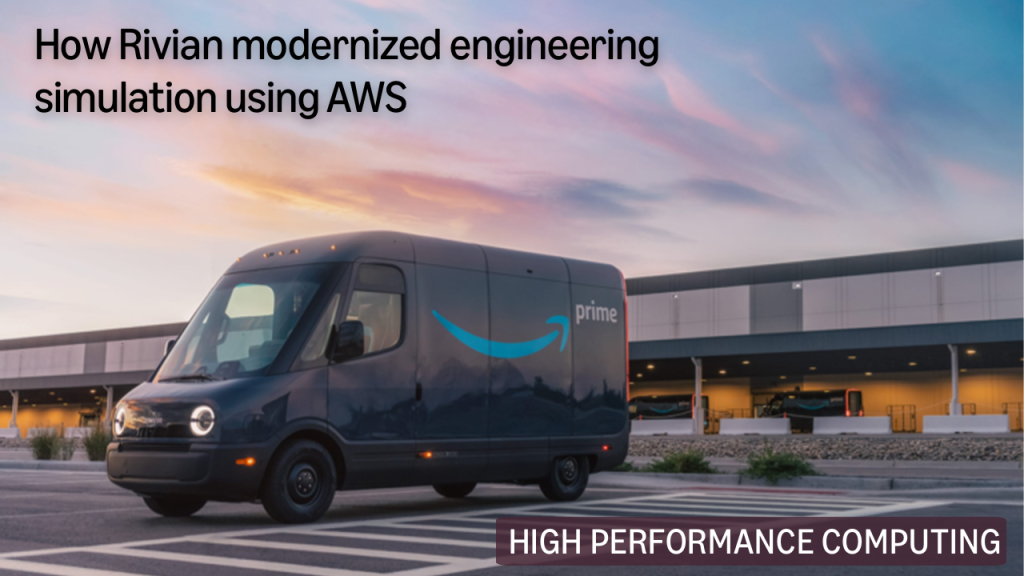
How Rivian modernized engineering simulation using AWS
This post was contributed by Ameya Kamerkar (Rivian), Vikram Pendyam (Rivian), Abhishek Chauhan (Rivian), Ajay Paknikar (AWS), Sandeep Sovani (AWS) Figure 1. Rivian’s custom Amazon Electric Delivery Vehicle (EDV) (Credits: Rivian media kit) In this post, we share how Rivian, a leading electric vehicle manufacturer, revolutionized their engineering simulation capabilities by migrating to AWS and […]

How Proteros accelerates drug discovery by using AWS ParallelCluster
Proteros is a leader in structure-based drug discovery solutions, and supports pharmaceutical, biotechnological, and academic clients with advanced technologies like Cryogenic Electron Microscopy (Cryo-EM) and Protein Crystallography (PX). In this blog post, we’ll explore how Proteros implemented an HPC solution that scales with their scientific ambitions. We’ll talk about how they started with a secure […]

Running NVIDIA Cosmos world foundation models on AWS
Running NVIDIA Cosmos world foundation models on AWS provides powerful physical AI capabilities at scale. This blog covers two production-ready architectures, each optimized for different organizational needs and constraints.
How Daiichi Sankyo modernized drug discovery using AWS Parallel Computing Service
This blog was co-authored by Takehiro Nakajima and Mark Azadpour from AWS and Rintaro Yamada, Rei Kajitani and Ryo Kunimoto from Daiichi Sankyo In recent years, the informatics field of drug discovery has seen a rapid increase in workloads requiring large-scale parallel computing, such as genome analysis, structure prediction, and drug design. Daiichi Sankyo has […]